Artificial intelligence has transitioned from a futuristic concept to an indispensable reality that is fundamentally reshaping how we live, work, and interact with technology. As we navigate through late 2025, the AI revolution has reached unprecedented heights, with innovations like ChatGPT, autonomous AI agents, and multimodal systems becoming integral to both business operations and everyday experiences. This comprehensive guide explores the transformative impact of artificial intelligence across industries, workplaces, and personal lives, revealing why 2025 marks a pivotal year in the evolution of intelligent technology.
The artificial intelligence market is experiencing explosive growth, with projections indicating it could reach $1.3 trillion by 2032, driven primarily by generative AI applications and infrastructure investments. In India alone, the digital landscape is undergoing a seismic transformation, with over 850 million online users expected by 2026, creating unprecedented opportunities for AI-powered solutions. This massive adoption reflects a fundamental shift in how businesses and individuals approach productivity, decision-making, and innovation.etasolution+2thebusinessr
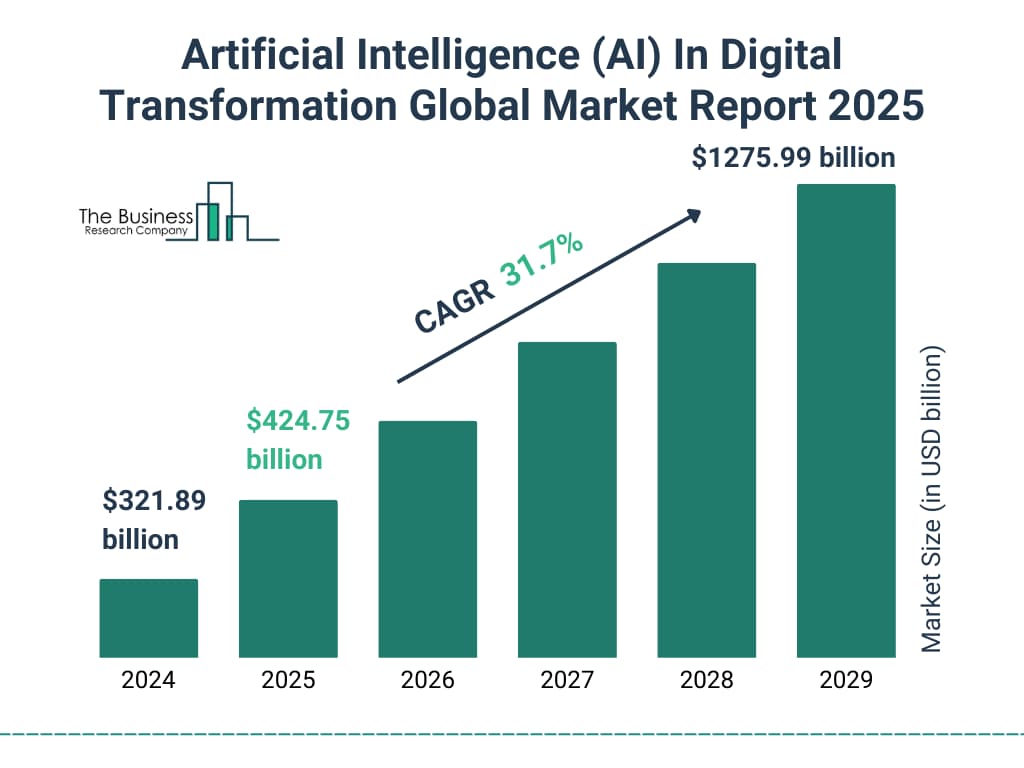
AI in Digital Transformation Market 2025 – Trends & Growth thebusinessresearchcompany
The Rise of ChatGPT and Generative AI: Revolutionizing Communication
ChatGPT has emerged as the flagship example of generative AI’s transformative potential, fundamentally changing how people access information and complete tasks. With over 34.74 million searches in India alone, ChatGPT ranks among the most sought-after technologies of 2025. The platform’s evolution throughout 2025 has been remarkable, introducing groundbreaking features that blur the lines between human and machine collaboration.infidigit
OpenAI’s latest innovations have transformed ChatGPT from a simple chatbot into a sophisticated AI agent capable of autonomous action. The newly introduced agent mode allows ChatGPT to “think” and “act” using virtual computing resources, managing complex task-oriented requests without constant human oversight. Users can now issue commands like “check my calendar and summarize upcoming client meetings based on the latest news” or “organize and purchase ingredients for a Japanese breakfast for four,” and the AI will execute these tasks independently.edition.cnn
The introduction of GPT-5 in summer 2025 represented a quantum leap in AI capabilities, offering what OpenAI calls “unified intelligence”—a system that seamlessly blends text, voice, document analysis, image understanding, and real-time internet access. This multimodal approach has made AI interactions more natural and contextually aware, reducing hallucinations by up to 50% while dramatically improving instruction following and practical utility.ttms+1
Real-time web access has been another game-changing update, enabling ChatGPT to provide current and accurate information on demand rather than relying solely on pre-trained data. This capability addresses one of the most significant limitations of earlier AI models, making ChatGPT a reliable partner for time-sensitive research, market analysis, and decision-making. Additionally, the personalized memory feature allows ChatGPT to remember preferences, past interactions, and recurring topics, creating progressively more intelligent and contextual conversations over time.linkedintheverge

A ChatGPT-powered smart home voice assistant may soon be a theverge
AI Transforming Business Operations: From Automation to Strategic Intelligence
Artificial intelligence is revolutionizing business operations at an unprecedented pace, with 80% of companies expected to have used generative AI models in their production environment by 2026, compared to just 5% in 2023. This explosive adoption reflects AI’s ability to deliver tangible business value through automation, enhanced decision-making, and operational efficiency.ringover
Automation That Scales: Reducing Costs and Boosting Productivity
One of AI’s most significant contributions to business is its capacity to automate repetitive tasks, freeing human workers to focus on strategic, value-driven activities. Small and medium-sized businesses are experiencing measurable improvements within weeks of implementing AI-powered automation. AI-powered chatbots now handle 70-80% of initial customer inquiries, qualifying leads before human intervention is required. This automation translates to substantial cost savings, with companies reporting reductions of 8-12 hours weekly simply by eliminating manual data entry through invoice automation.jaarvis
The impact extends across multiple business functions. In customer service, AI chatbots provide 24/7 instant responses, dramatically improving customer satisfaction while reducing operational costs. Retail and e-commerce brands using AI inventory management tools have reduced overstock issues by up to 30%, optimizing supply chain efficiency. Manufacturing companies leveraging AI for predictive maintenance have reduced equipment downtime by up to 50% and extended machinery life by 20-40%.businessnewsdaily+1
According to McKinsey research, AI’s long-term opportunity represents $4.4 trillion in added productivity growth potential from corporate use cases. Companies using AI-driven forecasting have reduced forecasting errors by 20-50% compared to traditional methods, enabling more accurate business planning and resource allocation. This productivity boost is not limited to large enterprises—even two-person marketing teams can now operate with the efficiency of ten-person departments by leveraging AI tools for content creation, social media management, and campaign optimization.mckinsey+2
AI-Powered Decision Making: Data-Driven Strategic Insights
Beyond automation, AI is fundamentally transforming how businesses make strategic decisions. Predictive analytics powered by sophisticated machine learning algorithms can analyze massive datasets related to industries, market conditions, and customer behavior to uncover hidden patterns and emerging trends. This capability enables executives to make proactive decisions rather than reactive ones, adjusting strategies before market shifts occur.thestrategyinstitute
AI agents are taking autonomous, goal-directed actions and processing workflows at unprecedented rates. These intelligent virtual assistants are transforming core technology platforms like CRM, ERP, and HR systems from relatively static systems to dynamic ecosystems that can analyze data and make decisions without human intervention. Organizations integrating agentic AI into workflows have experienced workflow acceleration of 30-50% in areas ranging from finance and procurement to customer operations.bcg
The practical applications are impressive across industries. In B2B SaaS, companies implementing agentic campaign routing have seen 25% increases in lead conversion rates. Financial institutions using AI for fraud detection and risk monitoring can autonomously detect anomalies, forecast cash needs, and recommend resource reallocation across accounts. Retailers leverage AI recommendation engines—with Amazon’s AI-powered system driving 35% of the company’s revenue—while Walmart uses AI for inventory management, reducing out-of-stock incidents by 30%.businessnewsdaily+1
Marketing Revolution: Personalization at Scale
AI has democratized sophisticated marketing capabilities, enabling small teams to execute campaigns previously requiring large agencies. Modern AI tools can create content tailored to ideal customers, automate social media posting and engagement, predict campaign performance, optimize advertisements in real-time, and personalize email campaigns based on customer behavior. Nearly 73% of consumers now trust content written by AI tools, reflecting the technology’s maturation in content generation.ringover+1
The shift toward AI-driven marketing extends to advanced capabilities like computer vision for quality control, which helps fashion retailers reduce return rates by up to 64% through virtual try-on technology. AI-powered visual data analysis enables businesses to monitor customer behavior through in-store cameras, identify shopping trends, and optimize store layouts for maximum conversion. These capabilities allow businesses to deliver personalized experiences at scale while maintaining cost efficiency.businessnewsdaily+1itsoli

The Role of AI in Driving Business Growth and Transformation itsoli
The Future Workplace: AI Augmentation and Human Collaboration
The integration of artificial intelligence into the workplace represents one of the most significant technological shifts in generations, fundamentally redefining what it means to work in the 21st century. According to McKinsey, up to 30% of hours worked across the US economy could be automated by 2030, with 12 million occupational transitions required by the same year. However, this transformation is not about wholesale job replacement—it’s about augmentation and collaboration between humans and machines.ibm
From Replacement to Augmentation: Redefining Work
The workplace transformation driven by AI manifests in three distinct ways: automation, augmentation, and adaptation. While some clerical roles will be replaced with technology—with the U.S. Bureau of Labor Statistics projecting declines of 5% in customer service positions and 10% in secretarial positions by 2032—the net effect on employment is expected to be positive. The World Economic Forum estimates that while emerging technologies might cause 85 million job losses globally over the coming years, they could simultaneously create 97 million new jobs.ibm+1
AI augmentation is changing how knowledge workers operate. Rather than spending hours on data analysis or routine knowledge-sharing tasks, workers are focusing on business objectives and creative direction, using AI to handle execution details. This shift is transforming skills requirements across industries, with 70% of work-related skills expected to change by 2030, a transition being accelerated by AI and generative AI.weforum+1
Generative AI could increase the productivity of professional users by 30-40%, according to PwC research. This productivity gain comes from AI handling time-consuming tasks like document processing, email drafting, meeting summarization, and content generation almost instantaneously. Workers are transitioning from content creation to curation and direction, spending less time creating from scratch and more time reviewing, refining, and guiding AI-generated outputs.ringover+1
AI Literacy: The Essential Skill for 2025 and Beyond
As AI becomes ubiquitous in the workplace, AI literacy has emerged as a critical competency. Business leaders recognize this urgency, with six out of every ten expecting AI and generative AI to transform their organizations. In the European Union, the number of professionals adding AI literacy skills to their profiles was 80 times greater in 2023 than in 2022, reflecting the explosive demand for these capabilities.weforum
Nearly half of employees surveyed by McKinsey indicated they want more formal AI training and believe it is the best way to boost AI adoption in their organizations. Companies that invest in employee AI capabilities are seeing tangible benefits. Organizations deploying AI at an operational level, rather than just a skills-based level, outperformed their peers by 44% on critical metrics such as employee retention and revenue growth.mckinsey+1
The most successful organizations are treating AI as a product, assigning design authority over AI processes, implementing control mechanisms, and creating human-in-the-loop fallbacks. This structural and cultural change requires businesses to embrace transformation fully, moving from AI-augmented workflows to AI-orchestrated execution with autonomously managed operations and continuously optimized processes.bcg
Collaboration Spaces and Hybrid Work
As AI tools handle more static, individual work, employees spend less time engaged in solo keyboard tasks and more time in collaboration. This shift emphasizes the need for different kinds of workspace design, with offices evolving into hubs for connection, interaction, and creative collaboration rather than locations for routine task execution. The widespread adoption of hybrid work models is accelerating this transition, making the office more of a place for human-to-human interaction while AI handles distributed, asynchronous work.cbre
AI in Everyday Life: Smart Homes, Healthcare, and Personal Productivity
Beyond business applications, artificial intelligence is deeply embedded in daily routines by 2025, making life easier, safer, and more efficient across multiple domains. The technology’s integration into consumer applications has reached a level where by 2025, there will be as many, if not more, digital voice assistants than humans on the planet—approximately 8.4 billion units.ringover
Smart Home Revolution: Automation for Convenience and Security
AI-powered smart homes have become increasingly common in 2025, offering unprecedented levels of automation, convenience, and security. Virtual assistants like Amazon Alexa, Google Assistant, and Apple Siri have evolved beyond simple voice command responses to predictive systems that anticipate needs based on daily patterns. Smart thermostats like Nest learn preferred temperatures during different times of day and adjust automatically, optimizing both comfort and energy efficiency.alnafi+1
Home security has been transformed through AI-powered facial recognition systems that identify visitors and detect unusual activity, providing real-time alerts to homeowners who can monitor their properties remotely. These advancements in AI-driven smart home technology offer greater peace of mind, efficiency, and energy savings, with systems automatically adjusting lighting, temperature, and security settings based on occupancy patterns and learned preferences.masterstudy+1
Healthcare Transformation: Personalized Medicine and Remote Care
AI is revolutionizing healthcare through enhanced diagnostics, personalized treatment plans, and remote monitoring capabilities. By 2025, AI systems diagnose diseases like cancer and diabetes with greater precision than traditional methods, analyzing medical images, patient data, and genetic information to suggest treatments faster and more accurately. AI-powered health apps enable individuals to track fitness, sleep, and mental well-being, with platforms like Apple Health and MyFitnessPal serving as personal health monitoring tools.pinecone
Telemedicine has become standard practice, with AI helping triage patients, guide them to appropriate care, and analyze symptoms through natural language processing in chatbots. This accessibility makes healthcare faster, more tailored, and more democratic. Early detection capabilities powered by AI are saving lives, with the technology acting as a silent guardian for many individuals by continuously monitoring health metrics and alerting users to potential issues before they become serious.masterstudy
Enhanced Personal Productivity: AI as Your Personal Assistant
AI personal assistants have become indispensable productivity tools in 2025. Siri, Alexa, and Google Assistant integrate with smart home devices, manage calendars, set reminders, send messages, and provide hands-free control over daily tasks. The key to maximizing these assistants’ potential lies in integration—connecting them with smart lights, thermostats, and other devices creates a seamless, hands-free lifestyle.pinecone
In the financial realm, AI is transforming personal finance management through robo-advisors that assist with investments and AI-powered fraud detection systems securing transactions. Applications like Mint and Wealthfront use AI algorithms to track spending, savings, and investments, providing personalized financial guidance based on individual behavior patterns. By 2025, AI offers increasingly sophisticated tools for managing personal finances, making financial literacy more accessible to broader populations.pinecone
Emerging AI Trends: What’s Next for 2025 and Beyond
Several cutting-edge AI trends are gaining momentum in late 2025, promising to further transform how we interact with technology and conduct business. Understanding these emerging patterns is essential for businesses and individuals seeking to remain competitive in an AI-driven landscape.
Agentic AI: Autonomous Decision-Makers
Agentic AI represents one of the most significant developments in artificial intelligence, moving beyond content generation to autonomous action and decision-making. Unlike generative AI, which focuses on producing content, agentic AI involves autonomous agents that take action, make decisions, and execute structured workflows with minimal human intervention. Powered by fine-tuned large language models, agentic AI agents can classify documents, extract and process enterprise data, and update backend systems while operating on defined goals, feedback loops, and contextual understanding.abiresearch
These agents enable full task execution from start to finish, transforming business processes in profound ways. Organizations deploying agentic AI have reduced low-value work time by 25-40% while accelerating business processes by 30-50%. The technology works 24/7, handles data traffic spikes without additional headcount, and minimizes human error through consistent, data-driven decision-making.bcg
Multimodal AI: Processing the World Like Humans
The future of AI extends beyond text processing to understanding the world through multiple senses. Multimodal AI, capable of processing and integrating information from various data sources like text, images, audio, and video, has made significant strides in 2025. This technology enables AI systems to understand context more comprehensively, leading to more accurate and nuanced responses across applications.ringover+1
OpenAI’s integration of multimodal capabilities into GPT-5 exemplifies this trend, allowing users to seamlessly switch between text, voice, image, and document interactions within a single conversation. The practical applications are vast—from visual data analysis and image recognition for security systems to real-time translation services that understand both spoken language and visual context.ttms+1
Edge AI: Intelligence at Your Fingertips
Edge AI brings computation closer to data sources, revolutionizing how we process and act on information. Rather than relying solely on cloud-based processing in massive data centers, Edge AI enables efficient AI models to run on small, low-power devices, bringing intelligence to everything from smartphones to IoT sensors. This shift reduces latency, enhances privacy by processing data locally, and enables AI functionality even without internet connectivity.cognitivetoday
The implications for consumer devices are substantial. By 2025, smartphones and other connected devices are positioned for strong upgrade cycles as consumers seek Edge AI capabilities. This trend supports the development of AI-powered computers and AI smart glasses, both of which are expected to become mainstream in 2025 and beyond.globalxetfs+1
Federated Learning: Privacy-Preserving Intelligence
As data privacy concerns intensify globally, federated learning is emerging as a powerful solution. This privacy-preserving AI technique allows models to be trained across multiple decentralized devices or servers holding local data samples without exchanging the data itself. By 2025, significant advancements in federated learning algorithms enable training models across decentralized data sources while maintaining strict privacy standards.cognitivetoday
Cross-silo federated learning represents a particularly exciting development, allowing federated learning across different organizations or domains. This technique opens new possibilities for collaboration while maintaining data privacy—particularly valuable in sensitive sectors like healthcare and finance where data sharing has traditionally been restricted due to privacy regulations.cognitivetoday
SEO and AI: Optimizing for the Future of Search
The intersection of artificial intelligence and search engine optimization is creating new paradigms for how content is discovered and ranked. Understanding these dynamics is critical for websites like InsightWire that aim to rank prominently in Google search results.
Voice Search and Conversational Queries
Voice search adoption is rising rapidly in India, with a majority of conversational queries being conducted in regional languages such as Hindi, Tamil, and Telugu, reshaping SEO keyword strategies. By 2025, 50% of voice search queries consist of four words or longer, indicating that conversational and long-tail keyword optimization has become essential. This shift requires content creators to focus on natural language patterns and question-based queries rather than traditional short keywords.applabx
The rise of voice search is closely tied to AI assistants like Google Assistant, Siri, and Alexa, which process natural language queries and prioritize content that directly answers user questions. Optimizing for voice search means creating content that addresses specific questions, uses conversational language, and provides clear, concise answers that AI assistants can easily extract and present to users.applabx
Mobile-First Indexing and Core Web Vitals
Google’s mobile-first indexing policy has made mobile optimization absolutely critical for SEO success in India, where mobile internet usage far exceeds desktop. 61% of mobile searchers are more likely to contact a local business if the business has a mobile-friendly website, emphasizing the importance of responsive design and fast loading times. Core Web Vitals—metrics measuring loading performance, interactivity, and visual stability—have become crucial ranking factors that directly impact search visibility.applabx
Websites must prioritize page speed, minimize layout shifts, and ensure seamless mobile experiences to maintain competitive search rankings. The emphasis on user experience signals reflects Google’s increasing reliance on AI algorithms like RankBrain and BERT to understand user intent and reward content that genuinely serves searcher needs.applabx
Long-Tail Keywords and User Intent
Long-tail keywords and conversational search phrases are increasingly being used in India’s SEO campaigns to better capture user intent and voice search queries. Rather than targeting broad, competitive keywords, successful SEO strategies in 2025 focus on specific, intent-driven phrases that align with how users actually search. 72% of marketers identify creating relevant content as the most effective SEO tactic to improve rankings and engagement.applabx
AI-powered SEO tools are growing rapidly among Indian agencies to automate and enhance various aspects of SEO workflows, from keyword research and content optimization to technical audits and performance tracking. These tools leverage machine learning to identify high-potential keywords, analyze competitor strategies, and predict content performance—giving businesses data-driven insights to guide their SEO investments.applabx
Local SEO and “Near Me” Searches
Local SEO has become increasingly important as 46% of all Google searches are related to local information, making it a priority for businesses targeting Indian consumers. The rise of “near me” searches reflects users’ desire for immediate, geographically relevant results. Businesses must optimize Google My Business listings, maintain consistent NAP (Name, Address, Phone) information across directories, and create location-specific content to capture this high-intent traffic.applabx
The emphasis on local search is particularly pronounced in Tier 2 and Tier 3 cities across India, where internet penetration is growing rapidly and users are increasingly turning to search engines to find nearby services, products, and information.applabx
Challenges and Considerations: Navigating the AI Revolution Responsibly
While the benefits of AI are substantial, the technology also presents challenges that businesses and individuals must address to ensure responsible and effective implementation.
Addressing AI Bias and Fairness
AI models can perpetuate and amplify existing biases present in training data, leading to unfair outcomes across applications from hiring algorithms to credit scoring. Explainable AI (XAI) has become a major focus in 2025, addressing the “black box” problem that has long plagued complex AI models. Advanced interpretation methods allow developers and users to understand how and why AI systems make specific decisions, improving transparency and accountability.cognitivetoday
The development of causal AI—systems that don’t just identify correlations but understand and model causal relationships—represents a significant leap forward in trustworthy AI. This advancement enables more robust decision-making and helps organizations identify and mitigate potential biases before they affect real-world outcomes.cognitivetoday
Data Privacy and Security
As AI systems process increasing volumes of personal and business data, privacy and security concerns have intensified. The adoption of federated learning and edge AI technologies addresses some of these concerns by keeping sensitive data local rather than transmitting it to centralized servers. Organizations must implement robust data governance frameworks, ensure compliance with regulations like GDPR and India’s Digital Personal Data Protection Act, and maintain transparency about how AI systems collect, process, and store user information.cognitivetoday
The Skills Gap and Workforce Transition
The rapid pace of AI adoption has created a significant skills gap, with demand for AI literacy and technical AI capabilities far outpacing supply. Organizations must invest in upskilling and reskilling programs to prepare their workforces for AI-augmented roles. This includes not only technical training on how to use AI tools but also developing critical thinking, creativity, and interpersonal skills that complement AI capabilities and remain distinctly human.ibm+1
The transition to AI-enabled work also raises concerns about cognitive overload and burnout. While AI removes mundane tasks, replacing them entirely with continuous critical thinking, problem-solving, and decision-making is unsustainable. Organizations must carefully adjust workloads and create balanced roles that combine AI-augmented efficiency with sustainable human engagement.cam
Ethical Considerations and Responsible AI
Recent incidents highlighting AI’s potential risks—from chatbots generating inappropriate content to concerns about AI therapy applications stigmatizing mental health conditions—underscore the need for responsible AI development and deployment. Organizations must establish clear ethical guidelines, implement human oversight mechanisms, and prioritize safety and wellbeing in AI system design.techcrunch+1
The development of industry-wide benchmarks for evaluating AI systems is gaining traction, with metrics extending beyond operational performance to include fairness, bias, transparency, privacy, and regulatory compliance. However, current adoption remains limited—only 39% of C-suite leaders use benchmarks to evaluate their AI systems, with most focusing on operational and performance metrics rather than ethical considerations.mckinsey
Conclusion: Embracing the AI-Powered Future
Artificial intelligence has irrevocably transformed the landscape of business and daily life in 2025, moving from experimental technology to essential infrastructure. The innovations in ChatGPT, agentic AI, multimodal systems, and edge computing represent just the beginning of a profound technological shift that will continue to accelerate in the coming years.
For businesses, the imperative is clear: 2025 is the turning point. Organizations that adopt AI strategically will scale faster, operate more efficiently, and deliver superior customer experiences. Those who ignore the transformation risk becoming uncompetitive as AI-native competitors and digitally mature incumbents pull ahead. The history of major economic and technological shifts—from the internet revolution to mobile computing—demonstrates that such moments define the rise and fall of companies.jaarvis+1
The opportunity extends beyond large enterprises to small and medium-sized businesses, startups, and individual professionals. AI tools have become accessible, affordable, and user-friendly, democratizing capabilities that once required significant investment and technical expertise. A two-person team can now compete with organizations ten times their size by leveraging AI for automation, marketing, customer service, and decision-making.jaarvis
For individuals, AI literacy has become as fundamental as computer literacy was a generation ago. The skills needed for work are changing by 70% by 2030, driven largely by AI adoption. Proactive learning, experimentation with AI tools, and development of complementary human skills—creativity, critical thinking, emotional intelligence—will determine professional success in this new era.weforum
The websites and businesses that will thrive in this AI-powered future are those that combine technological adoption with human-centered design. Success requires not just implementing AI tools but reimagining workflows, redefining roles, and creating cultures that embrace continuous learning and adaptation. As India’s digital economy continues its explosive growth toward 850 million online users, the opportunities for AI-driven innovation have never been greater.etasolution
The AI revolution is not something to fear but to embrace strategically and thoughtfully. By understanding the technology’s capabilities and limitations, investing in skills development, prioritizing ethical considerations, and maintaining focus on human value creation, businesses and individuals can harness AI’s transformative power to build a more productive, innovative, and prosperous future. The question is no longer whether to adopt AI, but how quickly and effectively you can integrate it into your strategy for success in 2025 and beyond.